
Guide
How commercial ceiling cleaning is priced.
Ceiling cleaning has no one-size price. Here’s how a job is measured, what moves the number and how the quote comes together.
Why there’s no single rate.
Two ceilings with the same footprint can be very different jobs. A tile grid in a low office, the open deck above a warehouse and a painted lobby two stories tall each take their own methods, their own equipment and their own amount of time. That’s why ceiling cleaning is priced from the building up, measurement by measurement, rather than read off a menu.
How we measure your job.
Square footage is the most common unit for flat ceilings. The crew works the ceiling plane in sections, so the area of each ceiling type drives most of the labor. A building that mixes tile, drywall and open structure is measured system by system, because each one moves at its own pace.
Tile ceilings are often counted as well as measured. The number of panels, the grid between them and the diffusers, return grilles and light lenses set into the plane all go on the count. Vents and light fixtures are frequently listed by the piece, since each one takes its own time whatever the size of the room.
Open ceilings start from the area worked, and the runs of duct, pipe and cable tray overhead set the rate, since they add surface a floor measurement misses. High dusting is often priced by the job, built from crew hours and lift days, and some projects are simply priced by the night when a set of zones is finished over several evenings.
Height, access and lifts.
Height changes everything overhead. A ceiling within ladder reach goes quickly. Once the work needs a scissor lift or a boom, the price covers the equipment, getting it into the building and the time spent repositioning it bay by bay. Racking, fixed seating, refrigerated cases and finished floors that need mats under the wheels all slow that movement.
Access is more than height. A ground-floor space with a wide door is simple. A tenant floor reached by a freight elevator with booking windows, or a mezzanine above a production line, takes more planning and more crew time.
Timing and the work around it.
Most ceiling work happens when the space is empty. Evenings, overnight shifts and weekends let the crew set up lifts and cover desks, tables and shelving without working around people, and your business stays open by day. The number of nights a building needs is one of the biggest pieces of any ceiling job.
Protection is part of that time. Covering workstations, displays, booths and floors, then resetting every area before opening, is labor the crew puts in on every visit. Grocery sales floors and restaurant dining rooms with a lot underneath take longer to protect than an empty warehouse bay.
What moves the price up or down.
Condition counts. A ceiling cleaned on a regular cycle comes back faster than one carrying years of dust and film. Restaurant ceilings near the kitchen pass-through, entries open to loading docks and rooms with heavy foot traffic hold more soil than a quiet private office.
What’s included is the other lever. Combining tiles, grid, vents and fixtures in one visit spreads the setup across more work, so each surface takes less effort to reach than it would on its own trip. Phasing works the other way: a first phase of lobbies and customer-facing rooms keeps the opening project smaller, with back-of-house areas added on later nights.
Location plays a part across the region. Crew costs run higher in San Francisco and the Peninsula than in Sacramento, Stockton or Reno, and each job is priced for the city it sits in.
Cleaning compared with replacement.
Replacing a tile ceiling is a different kind of spend. It buys new panels, often new grid to match, removal and disposal of the old material, and a longer interruption while rooms are cleared and the vents and fixtures set into the ceiling are worked around. New tiles also have to match across the room, which is hard in an older ceiling.
Cleaning keeps the tiles you already own. There is no material to order and nothing to haul away, the work runs in sections after hours, and the room is back in use the next morning. Where a handful of panels are stained through or sagging, replacing only those and cleaning the rest keeps the ceiling uniform, and the clean or replace guide explains how to sort them.
How three typical buildings would be measured.
Take a professional office with one tile floor: it would be measured by area, counted by vents and lenses, and finished over evenings from ladders. A manufacturing building with high-bay lights and pipe runs over the production floor would be priced by its structure, with lifts and access planned around shifts.
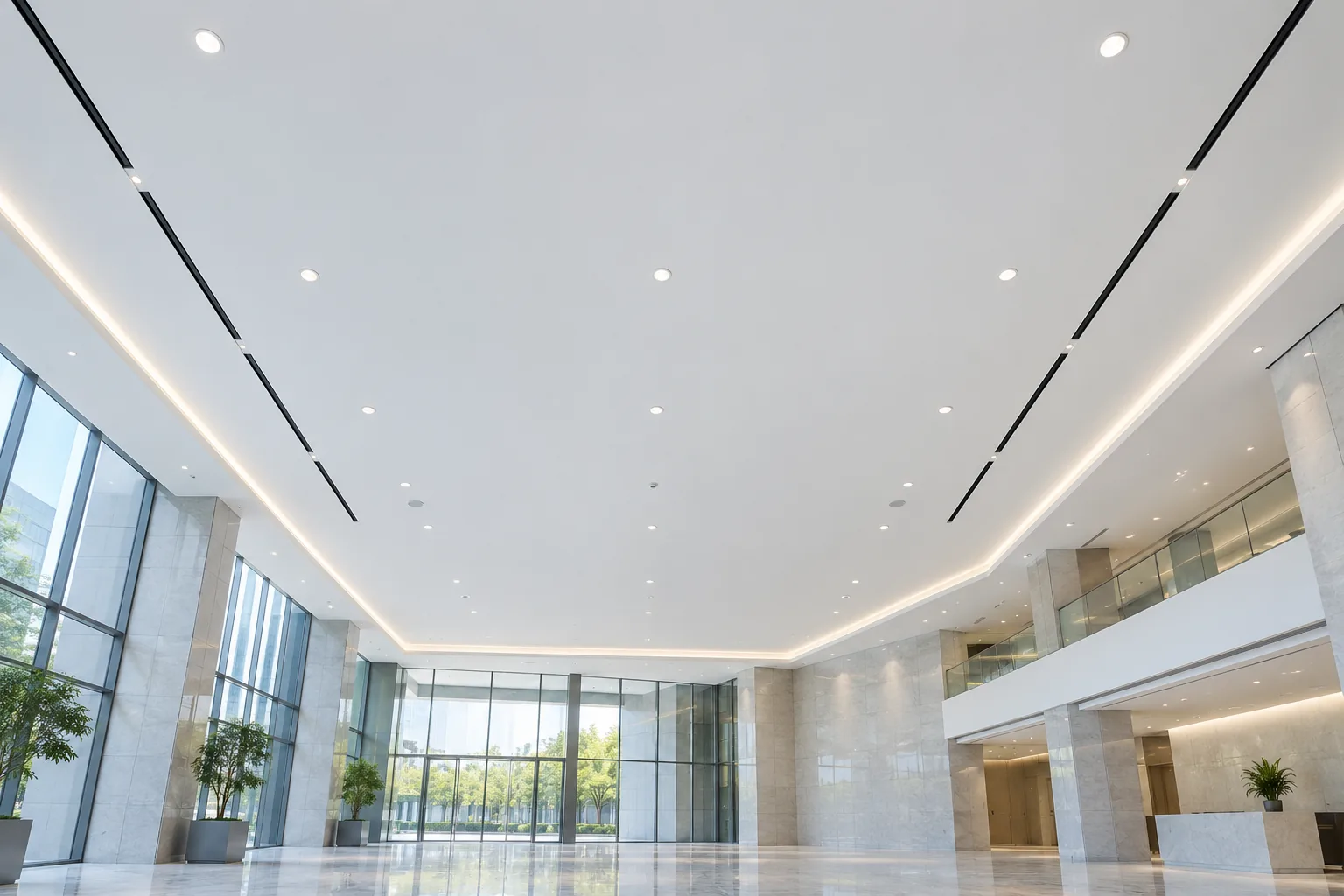
A retail center lobby with a tall painted ceiling and statement lighting would sit between the two: a modest area, but a lift, careful protection below and work timed around the stores’ hours.
How the walkthrough sets the quote.
Every price starts with a free walkthrough. We name each ceiling system in the building, measure the areas, count the tiles, vents and fixtures, check heights and access, and note what sits underneath and when each space is quiet. A small test area shows how your tiles respond, so the plan matches the result you will see.
You get the quote in writing, set out by area and service, so you can choose a full-building plan or a first phase. When you compare quotes, line them up on what’s included: which surfaces, whether grid, vents and fixtures are part of it, how many nights, what equipment and how the space below is protected. Book a walkthrough to get yours.
A few useful answers
Quick answers.
What unit is ceiling cleaning priced by?
Flat ceilings are mostly measured by square footage, and tile ceilings add a count of panels, vents and fixtures. Open ceilings start from the area worked, with the duct, pipe and beam runs setting the rate, and high dusting is often priced by the job.
Does a high ceiling cost more to clean?
Yes. Higher ceilings need lifts, more setup and more time to reposition equipment, and the price reflects all of it.
How does cleaning compare with replacing the tiles?
Cleaning skips new material, removal and disposal, and runs in sections after hours. Replacement brings all three, plus a longer disruption to the rooms below.
How do we compare two ceiling cleaning quotes?
Match what’s included first: the surfaces, grid, vents and fixtures, the number of nights, the access equipment and the protection below.
Can the quote be split into phases?
Yes. The written quote can show a full-building plan alongside a smaller first phase, so you start with the rooms customers see most.
Services