
Guide
How often restaurants and grocery stores need high dusting.
Dining rooms and sales floors collect dust overhead faster than most spaces. Here’s how often to plan for it.
Why these spaces need more attention.
Restaurants and grocery stores have constant traffic, warm air rising from the floor and big open ceilings. Dust and airborne grime settle on every horizontal surface above, and guests and shoppers notice the result even if they can’t say why the room looks dull.
Restaurant dining rooms and bars.
As a starting point, busy bars with open ceilings and pendants do well on a cycle of every two to three months, and most restaurant dining rooms about once a quarter, with open ceilings, pendant lighting and vents getting the most attention. Kitchen ceilings above the cook line and the outside of the hood canopy fit into the same overnight visit, so the whole restaurant runs on one schedule.
Grocery sales floors.
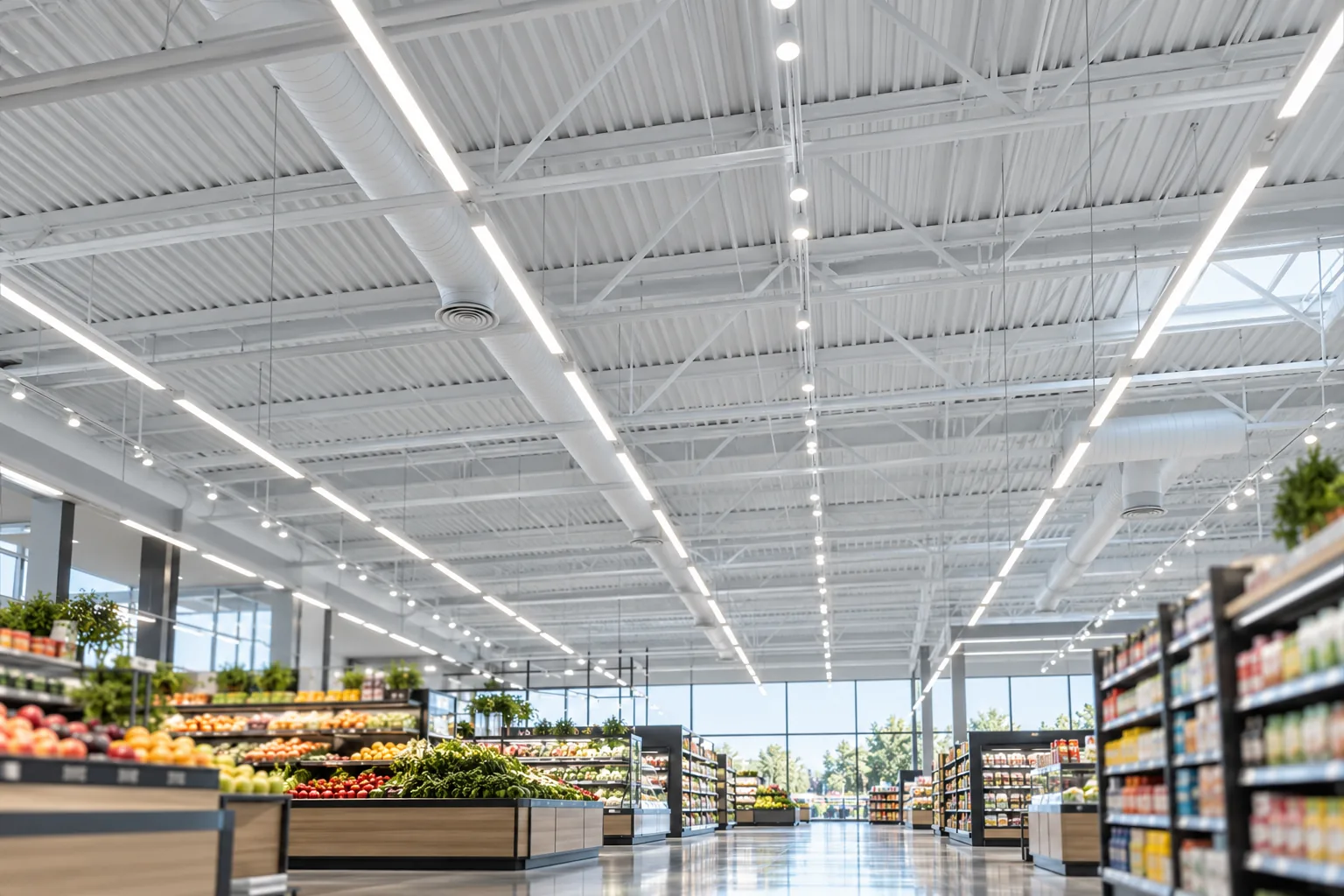
Grocery store ceilings are huge and high, with light rows, hanging signage and structure above every aisle. Two to four rounds of high dusting a year is a sound start, with entrances and bakery or produce aisles toward the shorter end, worked aisle by aisle so the store can stay open.Scheduling around service.
Restaurant work fits before opening, after close or on a closed day, and grocery work overnight or early in the morning. Either way, everything below is covered and protected.
Setting your own frequency.
Your traffic sets the interval. After the first cleaning we check how the ceiling holds up and set a schedule that keeps it looking its best. For offices, schools, hotels and warehouses, how often to clean commercial ceilings sets out a rhythm for each building type.
Signs your interval is too long
The ceiling tells you when a cycle has stretched too far. Grey edges appear along the tops of ductwork, pendants look dimmer than they did after the last visit, and dark rings creep back around the busiest vents. In grocery stores, the first clue is often dust visible on the top of a hanging aisle sign from the end of the aisle.
When you see two or more of these at once, bring the next visit forward and shorten the interval after it. Waiting longer means more buildup to clear each time and more dust drifting down between visits.
Building the calendar around your busy season
Restaurants and grocery stores both have peak periods when the room is full and the lights are on longest. Schedule an overhead visit just before that period starts, so the space is at its brightest when the most people see it, and avoid booking work in the middle of it.
A visit can also be tied to a planned change: a dining room refresh, a new menu launch or a store reset when shelving moves. Pairing the work with an existing closure means no extra downtime.
Splitting the work across visits
Large dining rooms and full grocery sales floors rarely need to be done in one night. Breaking the job into zones, such as the bar one night and the main room the next, or a block of aisles per visit, keeps each shift short and lets the business run normally.
Our overnight preparation guide explains what to set up before each of those nights.
A few useful answers
Common questions.
Should the bar and the dining room be on the same cycle?
Often not. Bars with open ceilings and pendants over them tend to show dust sooner, so they can be cleaned more often than the rest of the room.
Does every aisle in a grocery store need the same interval?
Aisles near entrances and bakery or produce areas with more airflow tend to collect dust faster, so we track them separately after the first visit.
Can high dusting be combined with vent and light cleaning?
Yes. Cleaning vents and light fixtures on the same visit keeps the whole ceiling on one schedule.
Services
Services this guide covers
Industries