
Guide
How commercial light fixtures are cleaned, from lenses to high-bays.
Dust and insects inside a lens dim a room long before anyone thinks to look up. Here’s how each kind of fixture is cleaned and how the work fits around your building.
How fixtures get dirty.
Light fixtures sit in the warmest air in the room. Heat from lamps and drivers draws air up and around each housing, and the fine dust it carries settles on top of the lens, along the frame and on every louver blade. Insects find their way into troffers through gaps around the door frame, drawn by the light and warmth, and their remains gather as dark specks across the lens.
The change builds so slowly that nobody notices it day to day. Fixtures that were bright and even at move-in turn patchy, with shadows wherever debris has piled up. Cleaning brings back the even, clear light the fixtures were chosen to give.
Troffers and lenses.
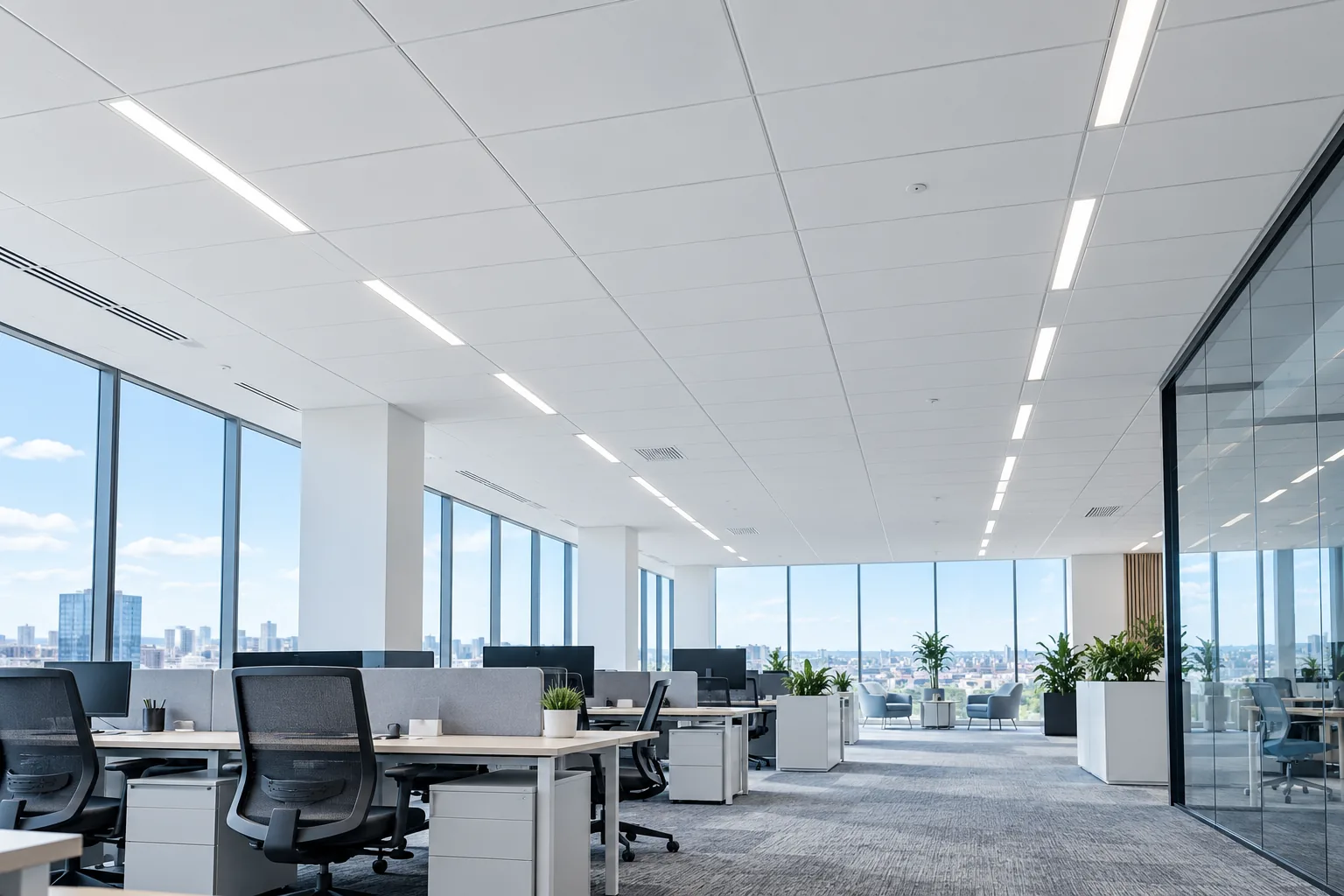
The recessed troffer is the workhorse of office and retail ceilings. Its door frame swings down or its lens lifts out, the lens is cleaned on both sides on a covered table, and the inside of the housing and its reflector are dusted before the lens goes back. Prismatic acrylic lenses turn brittle with age, so they are carried flat and supported, and any cracked lens is set aside and noted for your maintenance team. Flat LED panels have a sealed face that is wiped in place along with the frame.
Louvers.
Parabolic louvers, the shiny grid of cells in many older offices, hold dust on every blade, and their mirror finish shows streaks and fingerprints at a glance. Each louver is lifted out, cleaned with a soft cloth and a gentle method that protects the finish, and set back by gloved hands.
Pendants and track lights.
Pendants over dining rooms, lobbies and open offices gather dust on the tops of their shades, along their suspension cables and on the canopy at the ceiling. Each one is steadied by hand while it is cleaned so it doesn’t swing or knock against its neighbor. On open ceilings this work goes together with the ductwork and joists around the lights, as our guide to caring for exposed ceilings explains.
High-bays and lights above the aisles.
Warehouses, distribution buildings and grocery stores hang high-bay fixtures far above ladder reach. Dust drifts onto their tops and reflectors from the structure overhead, and the lens or guard underneath picks up a film from the space below. The crew works from lifts set on protected floors, cleaning each fixture from the top down. High dusting visits pick up these fixtures along with the beams, pipes and cable trays around them.
Power and safety, coordinated with the building.
Any fixture that gets opened is handled with its power off. Before the work starts, we plan with your facilities or maintenance team which circuits or zones are switched off, who switches them and how each area will be lit while the crew is up there. Your electrician or maintenance staff handle the switching and lockout, and the crew works one zone at a time so the rest of the space keeps its light.
Fixtures are left to cool before anyone touches them, especially older high-bays that run hot. The crew also hands the building a list of flickering lights, dead lamps, loose trims and cracked lenses found along the way, ready for your electrician.
Do fixtures in the same pass as the ceiling.
Cleaning fixtures alone lets their dust fall onto the tiles below, and cleaning the ceiling alone leaves dark lenses set in a bright plane. One visit solves both. The crew works from the top down, fixtures and vents first, then tile faces and grid, so nothing cleaned earlier collects dust again. The tiles themselves get the method their type calls for, explained in how acoustic ceiling tiles are cleaned.
Setup and protection happen once for the whole ceiling, which is why our vent and light fixture cleaning pairs naturally with tile or ceiling cleaning. For after-close work, our guide to preparing for overnight ceiling cleaning covers access and setup.
Troffers, pendants and high-bays in practice.
An office floor with rows of prismatic troffers, many speckled with insects, would have its circuits switched off zone by zone by the building engineer, its lenses cleaned on covered tables and the tiles around them done over the same weekend. Glass pendants over restaurant booths and track lights above a bar are usually cleaned from ladders before opening, and high-bays above warehouse racking from lifts on the same nights as the beams.
At a free walkthrough we count fixtures by type, check heights and access, and talk through power with your facilities contact. The written quote lists the fixtures alongside the ceiling areas around them.
A few useful answers
Quick answers.
How often should commercial light fixtures be cleaned?
Plan them on the same cycle as your ceiling cleaning. Busy restaurants, grocery stores and warehouses need it more often than quiet offices, and fixtures that collect insects show it soonest.
Why are there dark spots inside our ceiling light lenses?
Insects get into troffers through gaps around the door frame, drawn by the light and warmth, and collect on top of the lens. Opening and cleaning the fixture clears them out.
Does the power need to be off to clean light fixtures?
For any fixture that gets opened, yes. Your electrician or maintenance team switches off the circuits planned for each zone, and the crew works zone by zone so the rest of the space stays lit.
Will cleaning make our lights look brighter?
Yes. Clearing dust, film and insects from lenses, louvers and reflectors brings back the even, clear light the fixtures gave when they were new.
Can light fixtures be cleaned at the same time as the ceiling?
Yes, and it’s the order we recommend. Fixtures and vents come first, then the tiles and grid, so the whole ceiling finishes clean together.
Services